
Sherman Projected Versus Actual Release
TDCJ labels its field “Projected Release Date.” Classification and Records calculates it for a current inmate if parole does not produce an earlier release. The date is an administrative projection based on the law and information applied to that state sentence. It is not a release order, a promise, or proof that the person crossed the gate. Offense date and offense type matter because Texas release law has changed over time.
An actual release date records an event that already occurred. A release or discharge certificate, jail release sheet, or other custodian record can document that event and its legal form. A projected date can move before then. Even maximum expiration may not mean freedom if another sentence, detainer, warrant, or authority still holds the person.
Scheduled versus actual: Read a projection as a planning field, then use the custodian's release record to confirm the event and destination.
A pretrial detainee has no computed sentence end. Bond may permit release under court terms, but payment or an order can precede the final jail exit. Dismissal, remand, a new hold, or another court act can also change the result. Do not apply a TDCJ sentence formula to someone held only in Sherman County Jail before trial.
Find Sherman County Release Dates
Start by deciding whether the person is in Sherman County Jail, a TDCJ unit, or another system. The county record controls local jail processing. TDCJ supplies the active state-prison projection. A court judgment supplies sentence terms and jail-credit findings, but it may not show the minute when staff complete a physical release.
- Identify the current custodian. Call Sherman County Jail at 806-366-5551 for local custody or use the state locator for a known TDCJ transfer.
- Determine the legal stage. Separate pretrial detention, a short county sentence, and a state-prison sentence before looking for a date.
- Search by strong identifiers. Use TDCJ or SID number when known; otherwise compare name, conviction, sentence, and location details.
- Capture the exact label. Record “Projected Release Date” with the related sentence and offense data. Never rewrite it as “released on.”
- Check the source close to the event. Ask about holds, court changes, parole action, recalculation, and the record that will confirm actual release.
The Sherman County released inmate lookup covers the wider path when the custodian is not known. A person who disappears from one current-custody search may have transferred, been released, or fallen outside that system's scope.
TDCJ Projected Release Date Search
The TDCJ online inmate search accepts last name, first name, TDCJ number, SID number, gender, and race. Search by TDCJ or SID number first when possible. Otherwise use the narrowest supported name combination and compare identifiers before opening a detail record. The current unit is not the same thing as the county of conviction.
The locator includes only people currently incarcerated in a TDCJ facility. Its data is at least 24 hours old and updated on working days. That makes it useful for current state custody and the active projection, but not for Sherman County bond release or a historical archive of discharged people. Absence cannot prove release.
| Search item | How it helps |
|---|---|
| TDCJ or SID number | Provides the strongest route to the correct current state record. |
| First and last name | Finds candidates but requires comparison when names match. |
| Gender and race | Narrows a name search within the fields TDCJ provides. |
| Current location | Identifies the TDCJ unit, not the county where the case began. |
| Conviction and sentence data | Supplies context needed to avoid reading the date in isolation. |
| Projected Release Date | States TDCJ's current administrative projection for an incarcerated person. |
Sherman TDCJ Date Email Fallback
When the web search fails or more direct help is needed, TDCJ provides a no-charge inmate-information email channel. Email pia@tdcj.texas.gov, put the inmate's name in the subject, and give the full name plus seven-digit TDCJ number. If the number is unknown, supply exact date of birth. If that is also unknown, provide approximate age and county of conviction.
The official TDCJ email information page lists TDCJ number, location, conviction offense, incarceration history, current offense, county, court, and Projected Release Date among the available information.
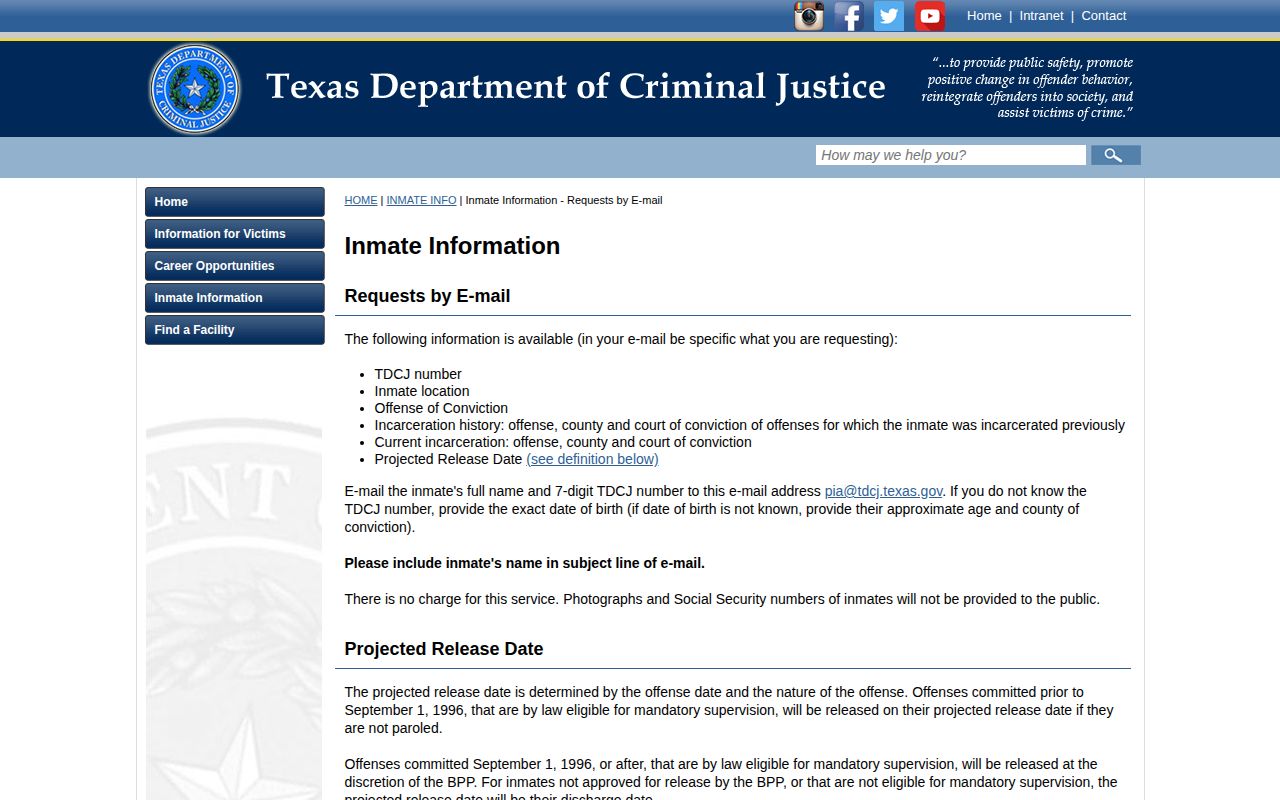
This free data request differs from a formal TDCJ Public Information Act request. After release, seek releasable release or discharge documentation rather than treating a vanished current record as proof. Formal requests may reach certificates and other public portions that the simple email channel does not provide.
Texas Good-Time Release Calculations
Texas Government Code Chapter 498 controls TDCJ good-conduct time. Section 498.003 says good-conduct time affects eligibility for parole or mandatory supervision and does not otherwise reduce the sentence itself. It is a privilege rather than a vested right. Classification and qualifying participation affect accrual, and Section 498.004 permits forfeiture.
The statutory classifications generally state twenty days for each thirty days actually served for trusty and Class I status, ten days per thirty for Class II, and none for Class III. Qualifying trusty prisoners may receive added credits. Those conditional rates do not mean every person gets the same reduction or that the court's sentence shrinks. A stand-alone calculator cannot know classification, forfeitures, eligibility, offense law, Board action, or every hold.
For an eligible mandatory-supervision case, Government Code Section 508.147 uses calendar time plus accrued good-conduct time within the statutory review framework. Section 508.149 identifies excluded offenses and the Board's discretionary denial standard. Offense date, deadly-weapon findings, prior law, new sentences, loss of credits, and detainers can change the practical result.
Good-conduct time: a TDCJ credit affecting release eligibility under stated rules. It does not erase part of the judicial sentence or guarantee release.
Texas Mandatory Supervision Dates
For qualifying offenses committed before September 1, 1996, TDCJ explains that mandatory-supervision release occurs on the projected date if parole has not happened first, generally when calendar time plus eligible good-conduct time equals the sentence. Later cases face a different framework. For qualifying offenses on or after that date, the Board of Pardons and Paroles also conducts discretionary review.
If the Board does not approve mandatory supervision, or the person is legally ineligible, a displayed projection can move to maximum expiration or discharge. Non-eligible records generally project flat calendar time to maximum expiration unless parole produces an earlier release. Later calculations and decisions can still change the displayed date.
Mandatory supervision is a form of release into legal supervision, not unconditional sentence completion. Parole is also supervised release, but it follows a Board decision. Discharge marks completion of the relevant sentence or supervision status. These terms should not be merged when asking when someone will leave a TDCJ unit.
Texas Has No General 85% Rule
Texas does not impose a blanket rule that every prisoner must serve about 85 percent of a sentence. For offenses and findings covered by Government Code Section 508.145(d), often linked to the former “3g” label and current Code of Criminal Procedure Article 42A.054, the accurate threshold is different. Actual calendar time, without good-conduct time, must equal one-half of the sentence or thirty years, whichever is less, and cannot be less than two calendar years before parole eligibility.
That calculation gives an eligibility threshold, not a release day. The Board can deny parole. It can also issue a decision tied to a future date or program, leaving the person incarcerated while conditions and processing continue. Other statutes and offense-specific rules differ. Never turn the half-sentence or thirty-year limit into a promised Sherman County release date.
Why Sherman Release Dates Change
A projected date reflects facts known and rules applied at one point. It can change after a new sentence, recalculation, disciplinary loss, court action, Board review, or a newly identified hold. The table separates common causes so the displayed date is not mistaken for a fixed appointment.
| Factor | Possible effect |
|---|---|
| Good-time class or forfeiture | Changes eligible credit and can move mandatory-supervision calculations. |
| Offense date or legal eligibility | Determines which parole and mandatory-supervision framework applies. |
| Board decision | Can approve, deny, defer, or condition release on a program or later date. |
| New sentence or court order | Can change the term, credits, sequence, or lawful basis for custody. |
| Detainer, warrant, or another hold | May cause transfer or continued custody even when one sentence reaches its date. |
| Administrative processing | Can separate an authorized date from the actual gate event. |
An absconder or warrant notation after supervised release does not erase the earlier release event. It indicates that supervision authorities allege loss of contact or seek custody. Verify it with the responsible agency and court rather than changing the original release date.
Sherman County Jail Date Calculation
No written Sherman County good-time policy or release-date calculator was found. State provisions aimed at particular county work-release classifications cannot be assumed to describe ordinary Sherman County jail credits. For a short county sentence, obtain the judgment, jail-credit findings, commitment, and the Sheriff's computation or release record. Ask how each credit was applied and whether another hold prevents release.
Sherman County Jail is at 701 N. 3rd St. in Stratford, and the jail and dispatch number is 806-366-5551. The Sheriff publishes no release-desk hours or local calculation guide. A caller can ask what document controls the calculation and how to request it, but should not ask staff to predict a legal outcome.
A pretrial stay works differently. There may be no sentence to calculate. Bond, court orders, warrants, holds, and processing control whether and when the person leaves. Bond permits pretrial release under court terms; it does not dismiss the case. A court docket can explain the order while the jail record supplies the actual processing event.
Sherman Weekend Release Rules Unpublished
Sherman County has not published weekend or holiday processing rules. There is no supported basis to say that a Sunday date automatically becomes Friday or Monday. A rule from another jail cannot be imported. Call the Sheriff near the expected event and ask whether the date is still current, whether staff can confirm the release status, and where the eventual event will be documented.
Administrative work can continue after a bond, court order, or computed date. Staff may need to check holds, warrants, identity, paperwork, or a receiving custodian. A transfer can occur on the same date that one local custody entry ends. Actual release manner is therefore as important as time.
Confirm Sherman Actual Release
Check the authoritative source close to the event. For county jail custody, call 806-366-5551 and seek the public booking and release record. For TDCJ custody, recheck the current detail, then obtain the appropriate release or discharge record after the event. The Texas Board of Pardons and Paroles decides parole and mandatory-supervision matters, while the TDCJ Parole Division supervises those released to parole or mandatory supervision.
Texas IVSS can provide alerts for county or state custody through separate systems, but a notice is not the release certificate. Registration steps and portal limits are covered in the Sherman County VINELink Inmate Search. When an alert arrives, record its source and event type, then verify whether it reports community release, transfer, or another custody change.
Texas Government Code Chapter 552 allows focused requests for existing public records, subject to applicable confidentiality and redaction rules. Ask for the date, release form, and segregable record rather than demanding that an agency calculate a future result. No statute, projected field, or missing search record proves that physical release occurred.