
Sherman County Parole Versus Probation
Parole is conditional release from a Texas prison before the sentence has fully ended. The Texas Board of Pardons and Paroles decides parole and mandatory-supervision matters. TDCJ's Parole Division then supervises a person released under those authorities. Probation is different. A Sherman County court can order community supervision as part of a judgment, sometimes instead of incarceration in a TDCJ unit. The Community Supervision and Corrections Department, or CSCD, administers that court order.
Those paths produce different records and office assignments. A jail release sheet can show when someone left Sherman County Jail. A parole record addresses release from state prison and later state supervision. A probation order comes from the court file. None should be substituted for another.
| Question | Parole | Probation |
|---|---|---|
| Who orders it? | Texas parole authorities after a prison sentence | The sentencing court |
| Who supervises? | TDCJ Parole Division | The responsible CSCD |
| Local route | Amarillo District Parole Office | Moore County CSCD directory contact |
| Does it prove jail release time? | No | No |
- Parole
- Conditional community release while a prison sentence remains active.
- Probation
- Court-ordered community supervision, which can occur without state prison.
- Mandatory supervision
- A statutory prison-release process subject to Texas eligibility and review rules.
- Discharge
- Completion of the sentence or supervision obligation recorded by the responsible authority.
Verify Sherman County Post-Release Supervision
Begin with the legal event, not a broad name search. Ask whether the person served a TDCJ sentence, received a Sherman County probation order, or merely left the county jail while the case remained pending. The Sherman County release search explains how the Sheriff record and court file answer the local release question.
- Identify the case and custodian. Use the official court record, judgment, or known TDCJ number. A bond release alone does not establish parole or probation.
- Check the state layer. For a prison case, review TDCJ offender information and, when appropriate, TDCJ IVSS for state custody and supervision events.
- Use the county crosswalk. The official TDCJ county-to-office directory maps Sherman County parole questions to Amarillo DPO.
- Check the court-supervision route. The CJAD locations directory groups Sherman with Dallam, Hartley, and Moore and lists Moore County CSCD in Dumas.
- Call before travel. Give reliable identifiers and ask which office may confirm public status. Privacy and safety rules may limit details.
- Obtain a record when timing matters. Ask the Sheriff for the release event and the proper state or court custodian for the supervision record.
A parole or probation match supports supervision status. It does not supply Sherman County Jail's physical release timestamp.
Sherman County Regional Parole Route
Sherman County has no published county-front-counter parole office. The official crosswalk sends its parole matters to Region V's Amarillo District Parole Office. This detail matters because searches for “Sherman” can lead to the City of Sherman in another part of Texas. Verify the county name, the Amarillo assignment, and the 806 area code.
The Region V office directory is the source for the address and telephone information below. Call to confirm the assigned officer or reporting location. An expected home address does not, by itself, prove which officer carries the file.
Amarillo District Parole Office, Region V5809 South Western St., Suite 120
Amarillo, TX 79110
Phone: 806-355-9218
Fax: 806-353-9572
The directory names Nicole Brooks. Staff can explain the proper public-status route, but may withhold confidential parole-file material. Texas Government Code Chapter 508 governs parole, and Section 508.313 protects specified information. A narrow request for public, segregable records is more useful than asking staff to disclose an entire file.
The official county routing is visible in the TDCJ crosswalk. The image below documents that source and should be read with the live directory because office listings can change.
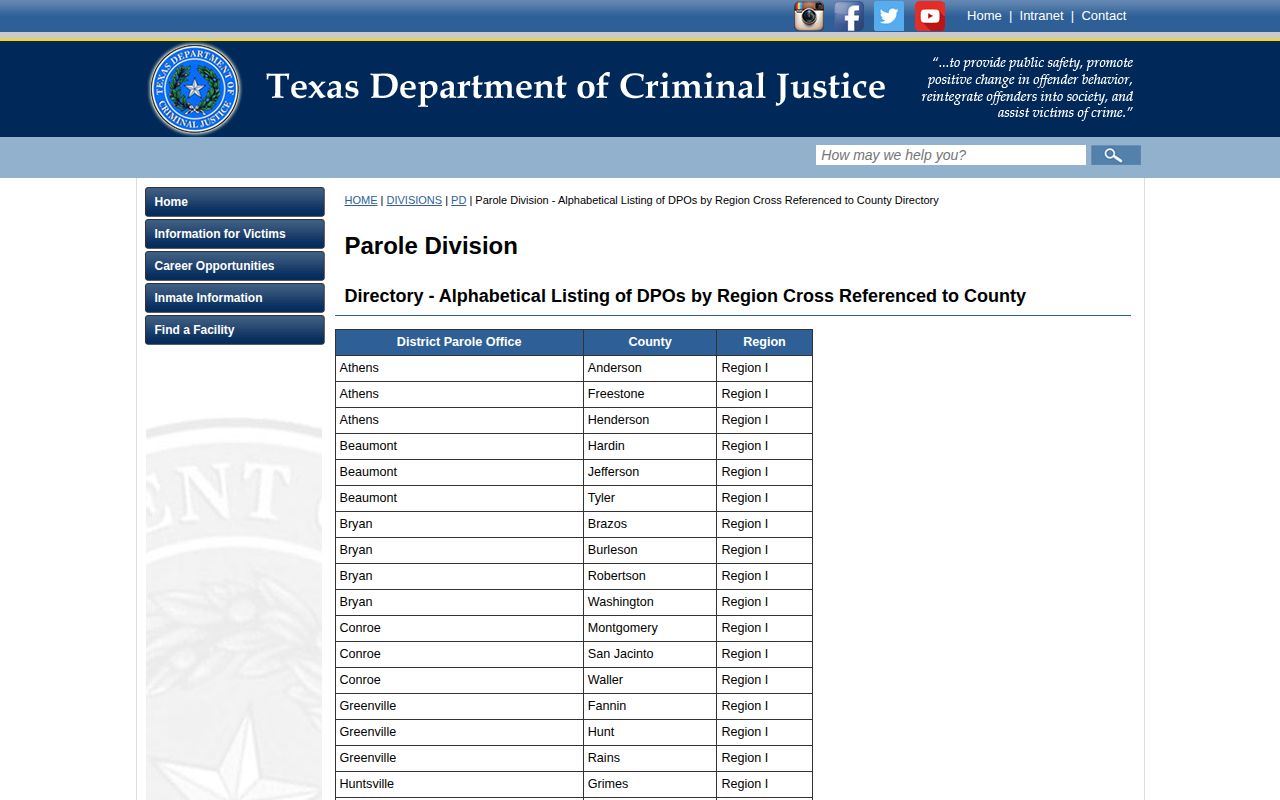
The crosswalk resolves geography, while the Parole Division record resolves the actual assignment.
Sherman County Probation Office Route
Probation records begin with the sentencing court and the CSCD administering the order. The CJAD directory places Sherman County in a four-county grouping with Dallam, Hartley, and Moore. Its listed contact is Moore County CSCD in Dumas. A person may have individualized instructions, so the directory address is not permission to report at that counter without checking first.
Moore County CSCD804 NE 4th St.
Dumas, TX 79029
Phone: 806-935-6945
Fax: 806-935-3577
Ask the combined Sherman County and District Clerk for the official judgment or community-supervision order when documentary proof is needed. The order may state the term and conditions, while the CSCD can route a permitted status inquiry. Neither record should be treated as the county jail's release event. A person can begin probation after a court action, remain on bond before judgment, or serve jail time under terms that require separate confirmation.
Sherman County Supervision Alerts
Texas IVSS systems provide notifications, not certified supervision records. IVSS-Counties covers participating county custody or supervision relationships. Its live language warns that someone no longer in custody may not appear. TDCJ operates a separate IVSS for state prison, parole, and mandatory-supervision events. A county registration does not automatically follow a later TDCJ sentence.
An alert may concern booking, release, court changes, escape, death, or transfer. Record the event and source, then verify it. For a state prisoner, TDCJ Victim Services can be reached at 800-848-4284. The Texas DPS Public Sex Offender Registry is narrower still. It applies only to people with a legal registration duty, so presence there does not prove parole or probation, and absence has no meaning for most released people.
Sherman County Violations and Absconders
Supervision conditions vary by judgment, release certificate, and officer instructions. They may address reporting, travel, treatment, contact, or other conduct, but a public page cannot establish a specific person's conditions. Obtain the controlling record or speak with the responsible office.
An absconder notation generally means supervision authorities allege that contact was lost or that custody is sought. It does not erase the original release. A warrant likewise requires confirmation from the issuing agency or court. TDCJ links a Sex Offender Absconder Information Search, but Sherman County publishes no general absconder list identified in the research. Do not infer a warrant from an unverified third-party page.
When the status is unclear, separate the questions. Ask the Sheriff about the county jail event, the clerk about a court warrant or probation order, and the Parole Division about a parole matter. This avoids turning a single stale result into a claim about current custody.
ID and Property After Release
Sherman County Jail publishes no procedure for return of property, release documents, or identification. Anyone planning pickup should call the jail before arrival and ask what identification is needed, where property is released, and how long it is held. No source supports a promise that jail staff issue a replacement ID.
For a lost driver license or identification card, use the official Texas DPS identification services. DPS explains replacement, renewal, document, and appointment paths. Required identity papers, such as a birth certificate, must meet DPS rules for originals or certified copies. Release paperwork and a state identity document serve different purposes.
Ending Sherman County Supervision
Supervision ends through the authority that imposed or administers it. TDCJ defines discharge as completion of the sentence and release from incarceration, parole, mandatory supervision, or community supervision. A parole release is not the same as discharge because the sentence remains active during supervision. Probation ends according to the court order and later court action, not merely because an online entry disappears.
For state records, a formal TDCJ Public Information Act request may seek the public portions of a release certificate, discharge certificate, parole or mandatory-supervision status, relevant dates, and board records. Confidential portions can be withheld. For probation, request the judgment and discharge or termination order from the proper clerk. Texas Government Code Chapter 552 governs requests for existing public records, subject to confidentiality laws.
Keep the final documents. Online tools are built for current status and may change after discharge. A saved official record is stronger than a later blank search.
Documenting Sherman County Discharge
A reliable discharge check starts with the agency that controlled supervision. For parole or mandatory supervision, ask TDCJ for the public portion of the discharge certificate and its effective date. For probation, request the signed termination or discharge order from the clerk for the court that imposed community supervision. Include the person\x27s full name, cause or TDCJ number when known, and a narrow date range. Exact identifiers reduce same-name errors and help staff locate an existing record without being asked to conduct open-ended research.
Compare the discharge record with the earlier release record. They mark different events. A person can leave prison on parole and complete supervision much later. Someone on probation may never have served a TDCJ sentence. If an online entry disappears, preserve the official response instead of assuming why it changed. Expunction, nondisclosure, data timing, or an office transfer can also affect public visibility.
Public Record Search
Sponsored Results